
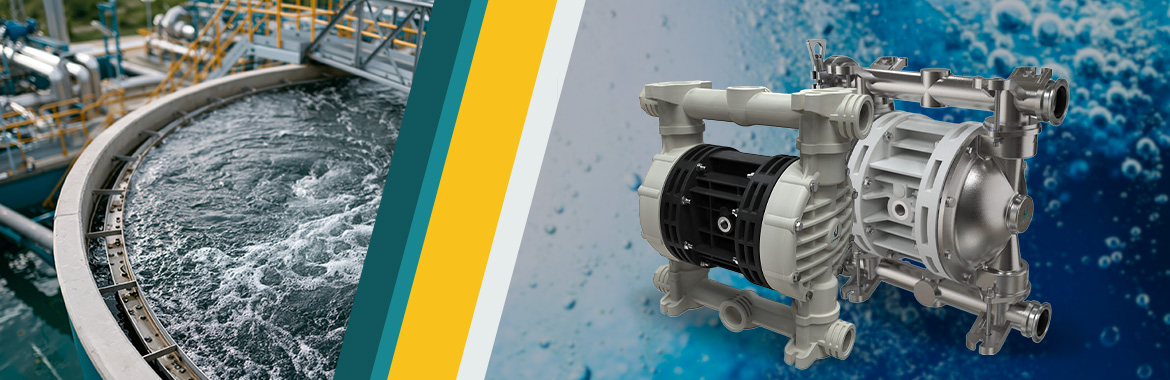
In many industrial sectors, the transfer of fluids from fixed tanks, reactors, drums and IBCs involves different suction conditions, which vary depending on the container and its position. Other variables affecting the transfer include the nature of the fluid, the acceptable amount of residue at the end of the operation, and the installation environment. Choosing a suitable tank emptying pump therefore requires an assessment of several factors, in addition to the required flow rate.
A pneumatic double-diaphragm pump may be suitable for these operations. To select the correct one, it is necessary to assess the characteristics of the fluid, the suction conditions and the intended configuration – whether stationary or mobile – together.
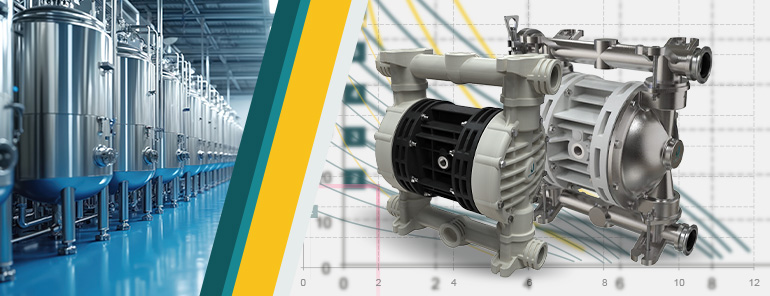
Why is tank emptying a critical operation?
During continuous transfer, a pump can operate under relatively stable conditions. In emptying operations, however, conditions change as the liquid level drops: the available suction head decreases and, in the final stages, the pump may draw in air along with the fluid. Residues or sediments may also remain at the bottom. The most common issues are:
- Variable suction: as the level drops, the available head decreases if the pump is below the liquid level; if it is above, the suction head increases.
- Final stages of emptying: the ingress of air into the line can cause flow irregularities or loss of priming, depending on the technology.
- Residues at the bottom: sediment, more viscous fluids or deposited solids can make it difficult to recover the product completely.
- Frequent connections: when working with multiple containers, the time taken to connect and disconnect them impacts the productivity of the operation.
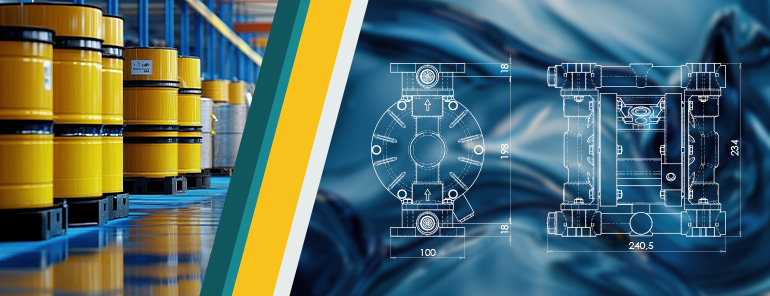
What variables affect drum and container emptying?
Each type of container or drum has different requirements. The table summarises the aspects to be checked before determining the pump configuration.
| Container | Typical extraction method | Points to check |
| Fixed process tanks | From the bottom or via a dedicated pipe | Required flow rate, line length, back pressure |
| Reactors and tanks | From the bottom or from the top | Fluid temperature, residues, material compatibility |
| Drums | From the top with a dip tube | Suction height, viscosity, ease of movement |
| IBC | From the bottom valve or from the top | Available fittings, frequency of container changes |
| Tankers and tank containers | Via flexible hoses | Flow rate, pipe length, installation area |
Required flow rate, line length, back pressure
Reactors and tanksFrom the bottom or from the topFluid temperature, residues, material compatibilityDrumsFrom the top with a dip tubeSuction height, viscosity, ease of movementIBCFrom the bottom valve or from the topAvailable fittings, frequency of container changesTankers and tank containersVia flexible hosesFlow rate, pipe length, installation area
When should you consider a double-diaphragm pump for tanks?
Pneumatic double-diaphragm pumps, or AODD pumps, transfer fluid through the alternating movement of two diaphragms. During emptying operations, the following features can be very useful:
- Self-priming capability: this allows fluid to be drawn from above, for example from drums and IBCs using a suction tube, within the model’s suction limits and under the conditions specified by the manufacturer.
- Ability to run dry: this is useful in the final stages of emptying, when the pump may draw in air. However, this must be checked in accordance with the manufacturer’s instructions.
- Absence of a rotating mechanical seal in contact with the fluid: this eliminates this component and the associated maintenance requirements.
- Pneumatic drive: no electric motor is required on the pump, a factor to be considered even in classified areas.
These features do not replace the need to verify the application. The size must be selected by comparing the required flow rate, suction conditions, back pressure and fluid characteristics.
Fixed or trolley-mounted tank-emptying pump?
When draining operations are carried out repeatedly at different points within the plant, it is advisable to consider a mobile configuration, as illustrated in the FDA BOXER 100 application case. The double-diaphragm pump, mounted on a trolley and connected via flexible hoses and quick-connect fittings, can be moved around the production area to drain tanks and process vessels. A fixed pump, on the other hand, remains the most suitable solution when draining always takes place from the same point and is integrated into a process line.
How should you choose the materials for a tank-emptying pump?
The compatibility of the pump must be checked for all components in contact with the fluid: pump body, diaphragms, balls, seats and seals. Double-diaphragm pumps are available in various materials, including polypropylene, PVDF and AISI 316 stainless steel, and the choice depends on the actual operating conditions. To assess the configuration, the following information is required:
- the composition of the fluid: chemical nature, concentration and any presence of solids or sediments;
- the temperature: both during transfer and during any flushing phases;
- the contact time: particularly when the fluid remains in the pump between one emptying operation and the next;
the specific requirements of the application: for example, the suitability of the materials for contact with the product and the required documentation, as in the FDA-compliant configuration for the application mentioned.

What data is needed to select a drum-emptying pump?
For a proper technical assessment, it is useful to gather the following information:
- type of fluid, technical data sheet and, where available, safety data sheet: to check the compatibility of materials;
- type of container and method of extraction: from the bottom, from the top using a dip tube, or via a valve;
- head between the liquid level and the pump, and the length and diameter of the suction pipework: to assess the most demanding conditions, generally at the end of the emptying process;
- viscosity, density and characteristics of any solids present, including size and abrasiveness: to assess the particle size and the available passageway in the pump;
- required flow rate and discharge back pressure;
- operating configuration: fixed or trolley-mounted, and any use of quick-connect fittings;
- installation area: any ATEX classification of the zone.
With this information, the Debem technical team can help you assess the most suitable pump size, materials and configuration for your application.
FAQs on tank-draining pumps
Can a double-diaphragm pump completely empty a tank?
It depends on the withdrawal method, the container’s geometry and the fluid’s characteristics. Dry running helps in the final stages, but does not on its own guarantee the complete recovery of the residue.
Can fluid be drawn from the top of a drum or an IBC?
Yes, with a dip tube, provided that the suction lift and the fluid characteristics are compatible with the limits of the selected model. Line pressure losses and the different priming performance dry and with a primed pump must also be considered.
Is a fixed pump or a trolley-mounted pump better?
A trolley-mounted pump is more suitable when emptying takes place at different points in the plant. A fixed pump is preferable when the operation always takes place in the same position and is integrated into the line.
What checks are required for draining tanks in an ATEX zone?
You must verify that the pump and the complete configuration are suitable for the zone classification and the operating conditions. The manufacturer’s instructions on earthing and on preventing electrostatic charges must also be followed, including for hoses, fittings and the trolley.