
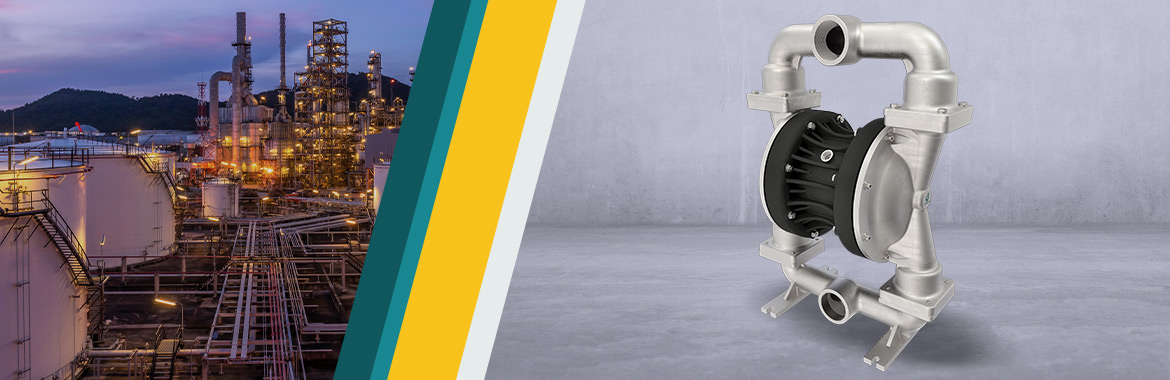
In fuel depots, industrial refuelling stations and Oil & Gas facilities, the choice between a mobile diesel transfer pump and a fixed solution affects operational times, the flexibility of operations, operator safety, and installation and maintenance costs. This article analyses the two approaches, sets out the selection criteria and explains when mobility offers a decisive advantage over a permanent system.
What is a mobile fuel pump?
A mobile fuel pump is a pumping unit – typically a pneumatic double-diaphragm pump – mounted on a transportable support (trolley, cart or skid) that can be moved and connected at different points within the plant according to operational requirements. A fixed solution, by contrast, is permanently installed on a dedicated process line, permanently connected to the suction and discharge pipework.
The main differences between a mobile pump and a fixed solution concern:
- Flexibility of use: the mobile pump can operate at multiple points within the depot using the same unit, whilst the fixed solution is restricted to a single point on the line.
- Installation time and costs: the mobile solution can reduce installation work compared to a fixed line, provided that the plant has suitable connection points, compressed air and earthing systems.
- Operational adaptability: the mobile configuration is better suited to variable situations (draining different tanks, product recovery, unscheduled maintenance).
- Maintenance: both solutions are compatible with AODD pumps, but mobility further simplifies access for inspection and component replacement.
When is it advisable to choose a mobile fuel transfer pump?
A mobile fuel transfer pump is preferable in the following operational scenarios:
- Depots with multiple drainage points: when tanks are spread across the site and require periodic bottom-draining operations, a single mobile unit can cover all points without duplicating the investment.
- Intermittent or seasonal operations: when fuel transfer does not take place continuously but on a scheduled basis (e.g. 5 days out of 7, as in the case of the ESSO Oil Depot in Bertrange), mobility avoids the permanent immobilisation of expensive equipment.
- Environments with variable layouts: facilities subject to refurbishment, expansion or reorganisation benefit from solutions that are not tied to a fixed location.
- Emergency or unscheduled maintenance operations: the mobile pump can be used as a rapid backup in the event of a fixed system failure, reducing plant downtime.
- Depots with an existing compressed air network: the availability of compressed air within the facility allows for the immediate integration of the pneumatic pump without the need to install an electric motor in an ATEX-classified area.
When, on the other hand, a fixed fuel transfer system is preferable
A fixed fuel transfer system is the correct choice when:
- Transfer takes place continuously at a single defined point on the line (e.g. constant supply to a generator or an industrial burner).
- The daily volume of fuel handled is high and requires constant flow rates without interruption.
- The system includes automation and remote monitoring integrated into the process line.
- Local regulations or the plant’s internal procedures require certified permanent solutions for a specific ATEX zone.
In these cases, the investment in a fixed installation pays for itself through operational continuity and a reduction in manual intervention.
The BOXER 503 ALU mobile fuel transfer system: a real-world application
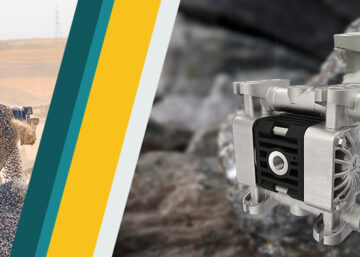
A concrete example of a mobile diesel transfer pump in an industrial setting is the installation at the ESSO Oil Depot in Bertrange, Luxembourg. The solution adopted is based on the DEBEM BOXER 503 aluminium double-diaphragm pneumatic pump, mounted on a stainless steel trolley and fitted with quick-connect couplings. The unit is used for draining tank bottoms and recovering the product from the lower collection points of the tanks, with a scheduled operating time of five days out of seven. The ability to quickly move the pump between different tanks in the facility, connecting it to existing lines via quick-connect couplings, has significantly reduced set-up times and increased the depot’s operational flexibility.
Technical criteria for selecting the right pneumatic pump for diesel transfer
Regardless of the configuration (mobile or fixed), the selection of the pump must take into account:
- Chemical compatibility: For diesel and compatible fuels, aluminium is often a suitable and cost-effective solution. AISI 316 stainless steel may be preferable in more demanding environments, where specific mechanical or corrosion resistance requirements apply, or when required by plant specifications; any hygiene requirements, however, must be assessed based on the pump’s design and certifications, not just the material.
- ATEX certification: In storage facilities classified as Zone 1 or 2, the pump must be certified for use in potentially explosive atmospheres. Pneumatic AODD pumps are particularly suitable for classified areas as they do not require an electric motor fitted to the pump itself; however, they must be selected in a version suitable for the intended ATEX zone, correctly earthed and installed in accordance with the applicable regulations.
- Flow rate and pressure: The pump size must be selected taking into account the required flow rate, head/back pressure, line pressure drops, suction conditions, available air pressure, and the viscosity and density of the fluid.
- Fittings and connections: Quick-release couplings (Camlock, DIN, etc.) are essential in mobile set-ups to minimise connection and disconnection times.
- Pipe length: In mobile configurations, it is preferable to keep the suction line as short and direct as possible, with an appropriate diameter, few bends and no constrictions, to facilitate priming and reduce pressure drops.

Mobile diesel transfer pump: summary of key benefits
The choice between a mobile and a fixed diesel transfer pump always depends on the specific operating context, the layout of the depot and the frequency of the required operations. The table below summarises the main comparison parameters to provide a quick and practical guide for assessment.
| Feature | Mobile solution | Fixed solution |
| Operational flexibility | High | Low |
| Installation cost | Low | Medium/high |
| Suitable for multiple drainage points | Yes | No |
| Integration with automation | Limited | More structured |
| Ideal for intermittent operations | Yes | No |
| ATEX certification | Available | Available |
For fuel depots that carry out scheduled draining and recovery operations across multiple tanks, the mobile fuel pump offers the best balance of flexibility, operating costs and ease of management.
To assess the configuration best suited to your specific operational requirements, the Debem technical team is available to provide personalised advice.