
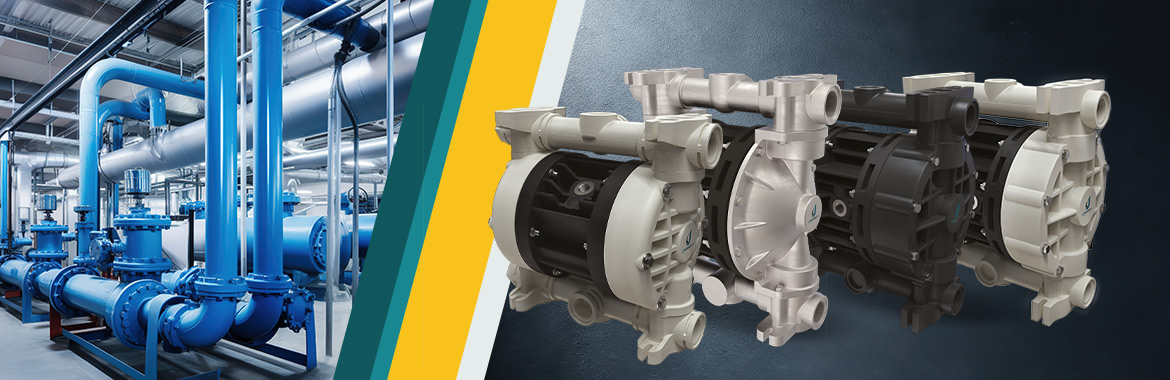
Double diaphragm pumps (AODD) are an extremely versatile solution for transferring fluids in various industrial contexts. This type of pump handles a wide range of viscosities, tolerates suspended solids and can adapt to aggressive fluids thanks to dedicated materials and configurations. The volumetric dimension, driven by compressed air, allows for linear flow control and limited mechanical impact on the product, with benefits in terms of repeatability and process safety.
What are double diaphragm pumps and how do they work?
A double diaphragm pump (AODD) consists of a body and manifolds, two air chambers, a pair of diaphragms connected by a shaft, a pneumatic distribution valve, and suction and delivery check valves. In terms of operation, an AODD pump drives two coupled diaphragms: compressed air, controlled by the pneumatic valve, alternates the pressure in the air chambers, generating suction and delivery cycles in the fluid chambers. The volumetric principle allows self-priming, line emptying and the transfer of dense fluids or fluids containing particles, ensuring good resilience to operating variations.

How to choose an AODD pump?
The successful application of a double diaphragm pump is closely related to compliance with actual operating conditions. During selection, it is useful to validate:
- Materials in contact and seals: these must be chosen in accordance with the chemistry of the fluids to be handled. Configurations in PP, PVDF or AISI 316L with PTFE diaphragms/seals cover a wide range of compatibility.
- Flow rate, head and viscosity range: it is necessary to read the curves, while the estimation of pressure drops and the presence of solids determine the size and the need for accessories (filters, regulators, dampers).
- Plant context and safety requirements: compressed air quality, piping layout, earthing and, where required, ATEX compliance.
When these elements are set correctly, the pump start-up conditions are faster and more efficient, washing times are shorter and reliability increases over time.
When to choose an AODD pump?
The use of a double diaphragm pump is particularly recommended when looking for:
- Protection of the fluid being transported: the diaphragm cycle generates low mechanical stress, making it very useful with shear-sensitive fluids, emulsions and suspensions.
- Flexibility in terms of fluids and conditions: wide range of viscosities and tolerance to soft and sized solids with excellent ability to handle frequent starts, emptying and transients.
- Simple flow rate adjustment: air-side control allows immediate set-point calibration without inverters or dedicated motors.
- Self-priming capability: useful feature when changing containers, performing purging operations or managing end-of-batch situations.
- Streamlined installation: possibility of mounting in different orientations, integration with dampers where necessary and reduced number of critical components.
- Compatibility and safety: wide range of materials available (PP, PVDF, aluminium and AISI 316L; PTFE membranes/other options) and ATEX versions for classified areas.
- Quick cleaning and format change: draining geometries and sanitary connections speed up washing and inspection operations.
- Control and monitoring: easy integration with air filters/regulators, pressure/flow indicators to improve repeatability.
These features make AODD pumps the benchmark choice when delicate transfers, frequent recipe changes and process stability with controlled operating costs are required.

5 operational steps for selecting and integrating a double diaphragm pump
In order to efficiently consolidate the start-up of the system, it is useful to define process data, set points and checks in advance, so that testing can be carried out with clear and documented parameters. Here is a list of operational steps that can be taken.
- Identify the fluid and its cycle of use: viscosity at operating temperature, presence/diameter of solids, foaming, shear sensitivity and service life (continuous/intermittent).
- Align compatibility conditions: choose pump materials and seals that are compatible with the fluids to be handled; in the presence of aggressive agents, consider PVDF/PP and PTFE.
- Size the pump for the actual line: define the target flow rate, estimate pressure drops and set consistent diameter measurements. Confirm the quality of the compressed air (filtering/regulation) and safety requirements (e.g. ATEX).
- Plan process control: provide for minimum instrumentation (pressure/flow indicators where applicable), any dampers and procedures for periodic verification of set points.
- Perform an application trial: validate the transfer parameters and stability targets on the actual product in order to lock in the configuration and avoid iterations during start-up.
Debem AODD pumps: wide range, customisation and support
Debem designs and manufactures double diaphragm pumps with a wide choice of materials and sizes, including configurations for aggressive fluids and ATEX options.
Technical support accompanies selection, configuration, integration and spare parts management, with a focus on reliability, safety and repeatability of results.