
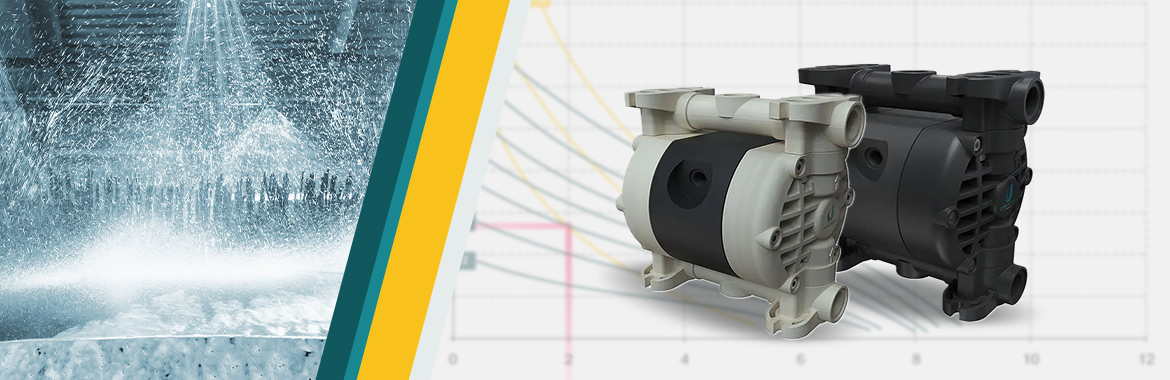
In industrial sanitation lines, the chlorine dioxide pump and foam cleaning system directly affect effectiveness, repeatability and safety. Unstable foam reduces the contact time of the detergent on surfaces, while inaccurate dosing of the ClO₂ solution can compromise water treatment and overall plant hygiene. It is important to remember that chlorine dioxide is an unstable gas: in industrial processes, it is never pumped as a gas, but always as a diluted aqueous solution, prepared on site or supplied in typical concentrations of 0.2%–0.5% by weight.
The use of unsuitable chlorine dioxide pumps can introduce air, generate pulsations and accelerate the wear of membranes and seals, with a direct impact on cleaning times and system reliability. To achieve stable dosing, homogeneous foam and faster, repeatable CIP cycles, it is essential to choose a ClO₂ pump and foamer feed designed for chemical compatibility, flow control and low shear.
Risks in pumping ClO₂ solutions
Inaccurate dosing of the ClO₂ solution or unstable foamer feed exposes the plant and operators to technical and health and safety issues. Here are the main risks to consider:
- Unsuitable materials: if the pump does not use compatible materials, membranes and seals can degrade rapidly, generating micro-leaks or oxidising aerosols that compromise the safety and hygiene of the department.
- Corrosion and line integrity: ClO₂ is a strong oxidant: even in diluted solution, it can accelerate corrosion on pipes and fittings if the materials are not chosen correctly (e.g. unsuitable steels, sensitive elastomers).
- Unstable dosing and concentration variations: undamped pulsations or air trapped in the circuit alter the actual concentration of ClO₂ in the treated water, causing under- or over-dosing and non-repeatable results.
- Less efficient CIP: non-draining geometries or rough internal surfaces promote stagnation and residues, lengthening washing times and making it difficult to standardise CIP parameters.
- Irregular foam cleaning: an uneven flow rate causes uneven foaming, with intermittent surface coverage and increased water and detergent consumption.
- Regulatory compliance at risk: leaks, fluctuating dosages and undocumented washing complicate audits and increase the risk of non-compliance in hygiene and sanitation processes.
In summary, these factors increase costs and operational complexity (TCO), reduce plant availability and compromise the quality of sanitation.
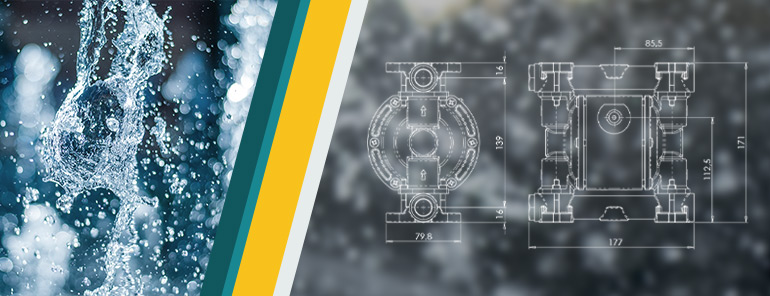
Requirements for choosing a chlorine dioxide pump (CIO2 pump)
To ensure safety and consistent performance, the pump must be designed with every detail in mind: technology, contact materials, drainage geometry and ease of cleaning.
- Double diaphragm technology (AODD): compressed air-operated double diaphragm pumps ensure constant flow rate, tolerance to short dry runs and gentle treatment of fluids. They are ideal for feeding both the foamer and the ClO₂ solution dosing lines, where flow stability is essential.
- Compatible materials: PVDF pump versions, with PTFE for membranes and gaskets, guarantee chemical inertness towards oxidants, surfactants and acid detergents.
- Drainage geometries and easy cleaning: internal shapes that promote emptying reduce stagnation and speed up washing cycles.
- Ventilated circuits or circuits with vacuum breakers: the integration of ventilated lines or lines with integrated vacuum breakers prevents the formation of residual gases and improves operator safety by preserving the integrity of the circuit.
Transforming risks into measurable results requires precise and validated technical choices: Debem’s approach integrates these requirements into ready-to-use solutions, with configurations, materials and accessories selected to ensure uniform foam, stable ClO₂ dosing and fast, repeatable CIP cycles.

Advantages of the Debem pump for chlorine dioxide ClO₂
The advantages of using a pump designed to handle ClO₂ solutions and foam cleaning allow operational complexities to be transformed into measurable efficiency using the following criteria.
- Single platform for foam and ClO₂ : with a single unit, both processes are managed, reducing the number of components in line, maintenance points and spare parts complexity. The system is more streamlined, easier to control and maintain.
- Measurable dosing quality: flow stability limits the concentration drift of the ClO₂ solution, ensuring consistent treatments and denser, more uniform foam, with up to +25% coverage and −30% water consumption per cycle.
- Reduced TCO and simplified spare parts: component durability, simple maintenance and reduced inventory complexity contribute to a lower total cost of ownership.

Request a technical assessment for your chlorine dioxide (ClO₂) pump
The Debem team will assist you in selecting and configuring the chlorine dioxide pump (CIO2 pump) and foam cleaning system best suited to your process, with attention to material compatibility, flow stability, operational safety and CIP traceability. Share your objectives and plant context: you will receive a targeted technical proposal and, if useful, an application test to validate in-line performance.